



Omar Monroy does not design in collections. She observes.
Her practice, El Techichi, unfolds slowly, piece by piece, guided less by market cycles and more by memory, land, and revelation. “I wait for it to come to me,” she says. An animal. A stone. A story. A moment that refuses to be ignored.
Jewelry, for Monroy, is not an ornament. It is a continuation. It is remembrance.
Born in Azcapotzalco and raised between Huajuapan de Leon and the United States, her relationship to land is layered. Back home, nature was constant: pitayas staining her brother’s hands red, her grandmother grinding beans with avocado leaves in the kitchen. In the U.S., nature became distant, something fenced off and reserved. That dislocation lingers in her work.

“We’re taught to leave in order to find beauty,” Monroy reflects. “But the land we come from is already beautiful. And so is the land we’re on.”
She speaks of Turtle Island and Abya Yala not as abstractions, but as living geographies. Her materials follow that same philosophy. Mexican fire opals discovered in a forgotten warehouse become serpentine earrings – stones discarded, then reclaimed. Cantera opals from Querétaro shimmer like cenotes. Cenotes host anacondas. “This idea of snakes renewing their skin, the serpent-like movement of the wire… it kind of follows me everywhere I go,” she says.
Shells sourced from Mexico anchor ruby drops. Coral gifted by a friend finds its way into asymmetrical compositions. Nothing is arbitrary. Everything carries lineage.
Pearls appear in nearly every piece and hold a divine meaning to Monroy’s heart. Their meaning traces back to 2020, before El Techichi fully formed, inside a small California bead warehouse, she wandered with her mother. As they moved through the aisles discussing the histories and memories attached to different stones, they eventually reached the pearl section.

“I told her, ‘Mom, I love pearls so much. They’re my favorite.’ And she said, ‘I love pearls too.’ I remember thinking, wait…how did I not know that? And she said, ‘You never asked.’ And she was right. I hadn’t.”
The exchange lingered with her. It became one of those quiet realizations that reshapes something fundamental. “It got me thinking about how much we don’t think of our parents as people until we get that kind of like aha moment, like, oh, my God, my mom is not just my Mom.”
Since then, pearls have remained central to El Techichi – not simply as adornment, but as quiet witnesses to that shift in perception and to a broader, deepened understanding.

Other pieces trace her brother through memory. Luis’ Tunas emerged from an archive of childhood photographs and recollections.
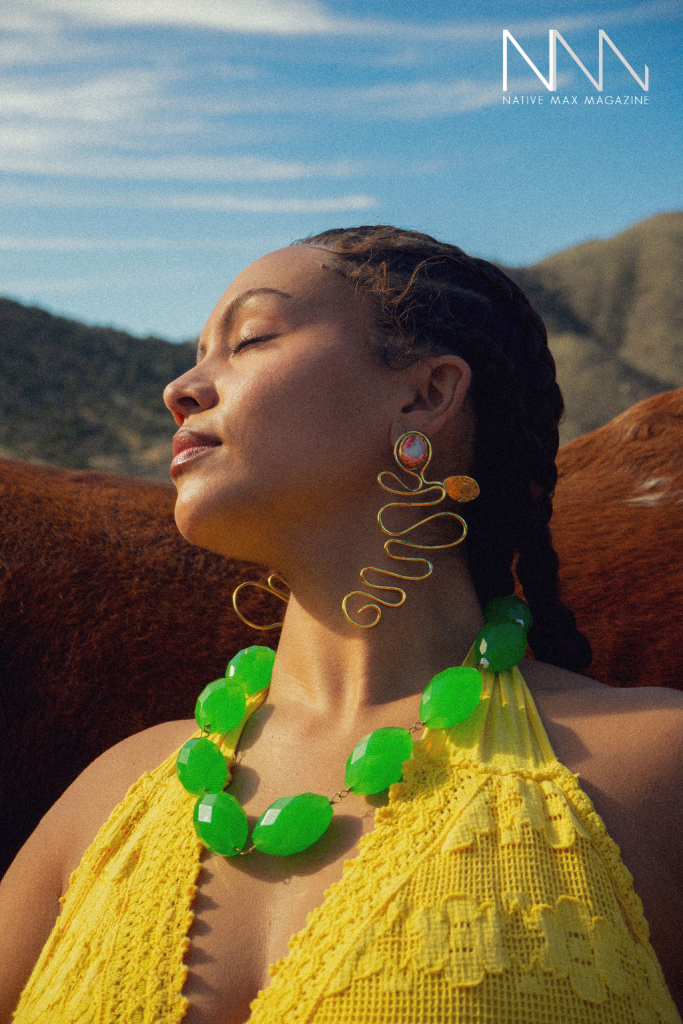
“When I was putting together a piece with those [green] glass beads, they kind of reminded me of tunas. When we were growing up in Huajuapan, there are photos of my brother covered in red from eating pitayas. When we came to the States, pitayas weren’t as common. Tunas were easier to find in California supermarkets. He loved eating them, so my mom would always buy them. I thought, ‘This necklace looks like a Tuna. And then it became, ‘Luis’ Tunas.’”

Monroy’s Mis Animalitos collection centers Mexican animals — Xolos, Ocelots, Cozumel Raccoons. The latter inspired a piece after she learned of their endangerment due to tourism and development.
“Some are dismissed as trash animals,” she says. “But they’re sacred too.” In her hands, they are restored to reverence.
Asymmetry defines much of her work. Nature, she reminds us, is rarely symmetrical. Vine-like wire coils into serpentine forms. Rather than beginning with classic Indigenous motifs, Monroy describes feeling spoken to: by plants, by shells, by interrelations she uncovers over time.

Morning glories, for example, reference Xōchipilli, a Mexica deity of art and queerness, and bloom through a pair of earrings.
Monroy resists mass production. There are no 30-piece collections, no seasonal drops. Each object is one-of-a-kind, often made from repurposed or gifted materials. She carves avocado
pits. She works with what the earth provides. Sustainability, for her, is not branding; it is inheritance.

“I had to start seeing the worth in myself and where I come from,” she says. “We have to look within.”
El Techichi does not chase luxury in the Western sense, though sapphires and opals gleam through her compositions. Instead, luxury is reframed as intimacy, with land, with family, with ancestral memory.
In a world that urges artists to simplify, replicate, and produce on demand, Monroy chooses slowness. Each piece carries part of her. She chooses story. She chooses continuity.
Jewelry, in her hands, becomes something more than adornment.
It becomes accession.

Credits:
- Creative and Photographer: Nat Armenta
- Designer: El Techichi
- Hat: Thunder Voice Co.
- Models: Zoey Reyes and Siyowin Peters