


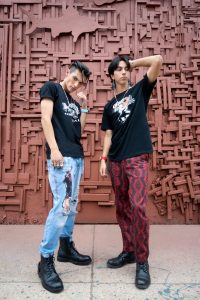
There is a particular kind of quiet that happens when a room full of young people realizes something is actually for them.
That quiet showed up more than once on August 14 at the Santa Fe Art Institute, where 4KINSHIP and Indigenous Futures 4EVER (IF4) launched Indigenous Fashion 4EVER in partnership with New York City’s Fashion Institute of Technology. The timing was intentional: Santa Fe Indian Market week, when the city fills with Native artists, buyers, designers, collectors and relatives from everywhere. The premise was simpler than a recruitment pitch and a lot bigger than one.

Indigenous young people are already imagining the future. The work is making sure they have the networks, education, mentorship and tools to go build it.
A day built around kinship
Diné designer Amy Denet Deal, founder of 4KINSHIP and IF4, and an FIT alumna herself, set the frame early. KINSHIP was more than a theme. It was the actual architecture of the day: creativity, community, education, and opportunity treated as one interconnected thing rather than four separate lanes.

The talent of Indigenous youth is plentiful, but access to opportunity has not always been. This was about bringing one of the world’s leading fashion institutions directly into Indigenous space while surrounding our young relatives with people who have built careers across the creative economy. We wanted every young person in that room to understand that there isn’t just one path into fashion and the business of fashion — there are hundreds.
Amy Denet Deal, founder of 4KINSHIP and Indigenous Futures 4EVER
Santa Fe Mayor Michael Garcia opened the program, tying the day to something concrete: New Mexico’s creative economy, and who gets to build a career inside it.
This summit gives young people the opportunity to see what is possible, connect with mentors and educators, and discover pathways to careers in an industry where creativity, culture and entrepreneurship come together. We want our young people to know they can build meaningful careers, launch businesses and shape the future right here in New Mexico.
Santa Fe Mayor Michael Garcia
Senator Angel Charley also joined the gathering in support of the students and the launch.

The morning: everything fashion actually is
If you have ever been told that a career in fashion means becoming a designer or nothing, the morning session was a corrective.
FIT deans, faculty, leadership, and students walked students through academic pathways across art, design, business, technology, communications, and social justice, and, more usefully, described what studying there and entering the industry actually looks like day to day. The visiting delegation included Mathilde Perez, Vice President of Enrollment Management and Student Success; Nicole Ndzibah, Executive Director of the Social Justice Center; Troy Richards, Dean of the School of Art and Design; Shannon Maher, Dean of the School of Business and Technology; and Joshua Whitehead, assistant professor in the School of Art and Design.

From there the conversation widened out across the industry. Designer Josh Tafoya, recipient of the 2026 Cooper Hewitt National Design Award, spoke about building an Indigenous luxury fashion house rooted in culture, craftsmanship and innovation. Jacob Sanchez, design director at Thunder Voice Hat Co., talked sustainability and collaboration. Costume designer and supervisor Shann Otto showed students where fashion meets New Mexico’s growing film industry. Attorney Justin Reyna gave students the unglamorous, essential version — contracts, intellectual property, and how to protect your work before someone else profits from it.
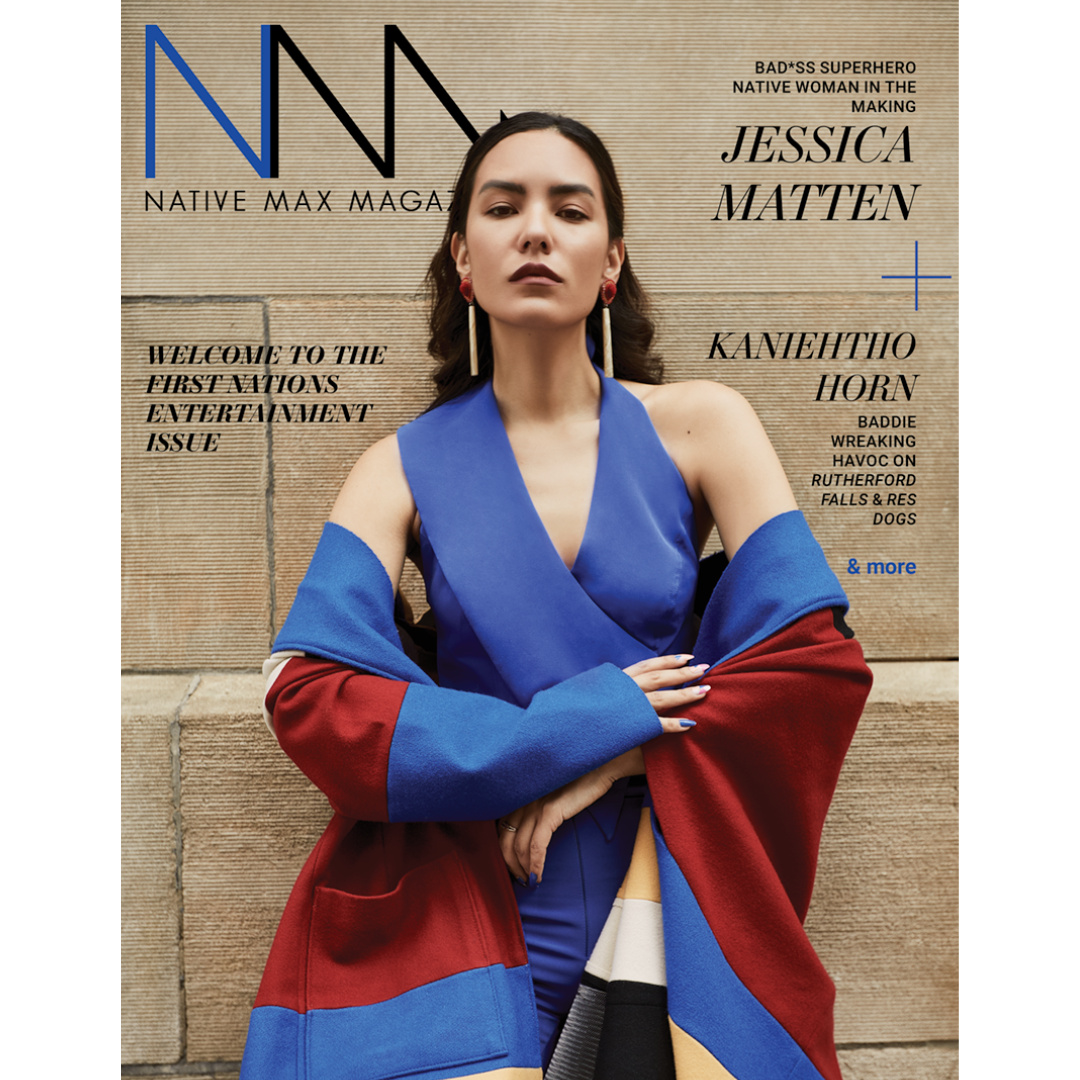
Native Max founder Kelly Holmes spoke to the part of the industry that decides which stories travel: Indigenous storytelling, publishing and media, and the power our own platforms hold in shaping global conversations about fashion and culture.
Then the mic went to the people the students most wanted to hear from, current FIT students, in a candid conversation moderated by emerging Indigenous designer Quentin Anderson. The real thing: what college is like, what is hard, what nobody tells you.
I really liked the experience. I found all the information very useful as someone who wants to go into the fashion industry and has had FIT as a top choice for years. As a Native person who is interested in fashion, I feel like fashion is a very effective way to represent cultural teachings and knowledge. … After attending this event, I feel more motivated and prepared for the application process.
Sierra Nakai (Navajo), senior at Navajo Preparatory School

The afternoon: the hang
Here is where the day earned its name.
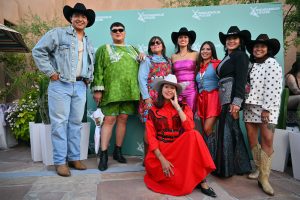
After lunch, students helped clear 150 chairs out of the gallery, and the whole building changed energy. Artist, DJ, and vibemaster Randy Barton took over the courtyard with music and a steady supply of uncle wisdom, and the afternoon turned into what organizers had been calling, from the beginning, the hang.

Studio tables became resource stations. The library became a portfolio review space, where any young person thinking about fashion school could sit down with FIT and get real feedback on their artwork. FIT staff set up in the studios for one-on-one conversations about admissions, scholarships, financial aid, and what a first year actually costs. Community partners like Protect The Sacred, Human Rights Alliance, Native Change Labs, CAMP 3.0: Cyclical Artistic Mentorship Program, and San Juan College Big Idea Makerspace filled in the rest.
The design was deliberate. Mornings make you believe something is possible. Afternoons are when you walk up to a stranger and ask, how did you do that?

It was really inspiring to meet some of the artists like Josh Tafoya and learn how they got started in the field. … This program focused on Indigenous youth and how they can be part of the larger fashion industry. It showed us that this is more than just one thing — there are so many different things that can go into this, and the career opportunities are endless.
Sabrina Gutierrez, visual art teacher, Navajo Preparatory School
What happens after everyone goes home
August 14 was never meant to be a one-day event, and 4KINSHIP has a track record that backs that up. Through IF4’s skateboard initiatives, 10,000 complete skateboards have been distributed directly to Indigenous youth and communities, built on a simple philosophy: create access, build relationships, and whenever possible, put an actual tool in a young person’s hands.
Now they are applying the same logic to fashion. 4KINSHIP and IF4 have committed to fundraising to give every Indigenous young person who attended Indigenous Fashion 4EVER their own sewing machine this fall.
The point is not to tell a kid they could be a designer, a maker, an entrepreneur, a costume designer, or a creative director. The point is that when they get home and think, ” Maybe I could make something, and I know how to start.”
To help put a sewing machine into the hands of an aspiring Indigenous creative, text GOMAKE to 707070.
The initiative continues to build relationships with the Institute of American Indian Arts, Native-serving educational organizations, regional designers, Tribal communities, and leaders working to grow Indigenous representation across the creative economy. This was step one.
Our young relatives got to sit in a room surrounded by people saying: there is a place for you here. There are pathways you may not even know exist yet. And there are aunties, uncles, educators, mentors and industry leaders who are ready to help you find them. … That’s what this was really about. Opening the door — and making sure it stays open.
Amy Denet Deal