






Andrea Grant grew up between worlds. As a Coast Salish woman shaped by both ancestral territory and urban life, she kept feeling ancestral stories surface in the middle of city streets, subway rides, and crowded apartments. Rather than see that as a contradiction, she turned it into a book.
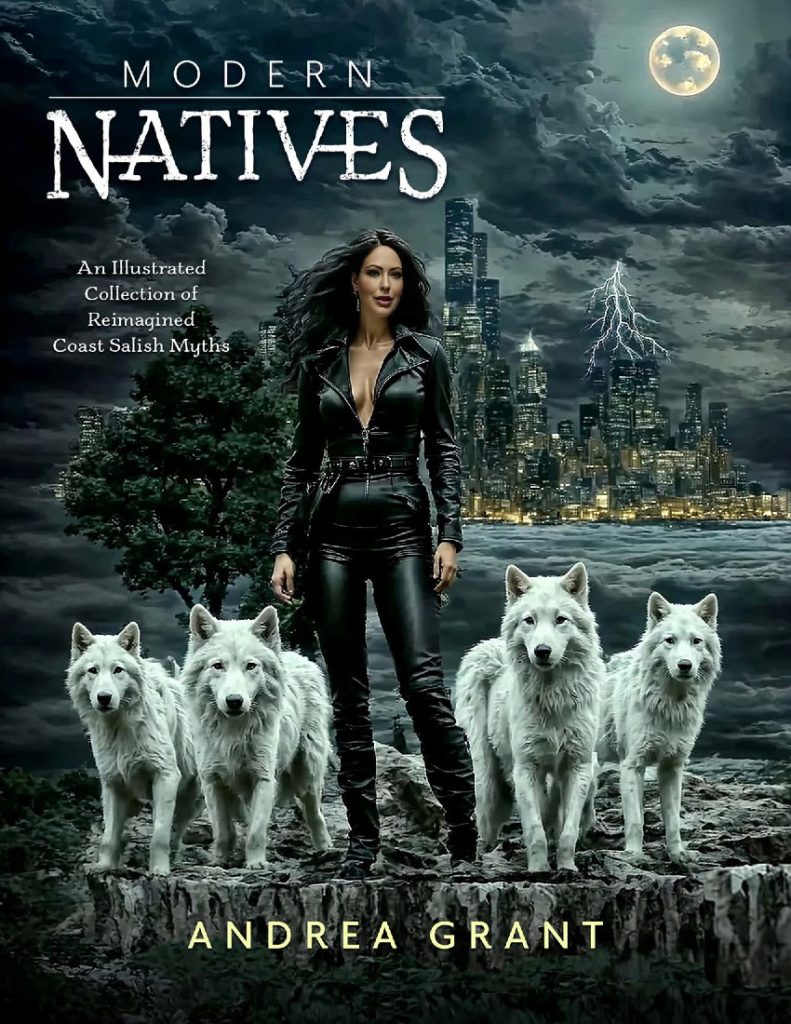
Modern Natives: An Illustrated Collection of Reimagined Coast Salish Myths is Grant’s newest work, a collection that reimagines Coast Salish ancestral stories in modern settings, with tricksters walking city streets, wolves appearing beneath streetlights, and ancient beings moving through urban Indigenous spaces. The book blends short fiction, poetry, and illustration, and was created with the knowledge and approval of Grant’s elders.
The project began in 2018 with a visit to Penelakut Island, where Grant connected with elders, storytellers, and community leaders through an invitation from Joey Caro of the Hul’qumi’num Treaty Group. Among them was Elder Thiyaus Florence James, who became a key mentor throughout the project.
“What moved me deeply was that the elders recognized something in my work,” Grant said. “They were interested in my graphic novel series MINX and my approach to storytelling because they saw the possibility of reaching younger generations through contemporary mediums.”
Before she left the island, the elders entrusted her with binders of lesser-known Coast Salish stories, some collected as far back as the 1950s. “They told me it was my destiny to help preserve these teachings in my own way,” Grant said. “It was one of the most transformative moments of my life.”
The collaboration with Elder Florence was ongoing and deeply reciprocal. Grant would send concepts, excerpts, and drafts for feedback throughout the writing process. Elder Florence taught her Coast Salish words and cultural nuances woven throughout the work, and helped Grant understand which stories belonged to the community and which could be adapted for broader audiences.
“Honoring Coast Salish protocol was ultimately about relationship, respect, listening, and accountability, not just to the stories themselves, but to the people and ancestors connected to them,” Grant said.

For Grant, the urban settings are not a departure from Indigenous identity but a reflection of it. “Our spirits, teachings, and ancestral connections do not disappear simply because the setting changes,” she said. “The spirits travel with us.”
She is direct about what she hopes the work offers Indigenous readers, especially young women: “I want them to feel seen, powerful, and connected to something larger than themselves. Our stories are not ancient relics disconnected from modern life. They are living knowledge systems that still have relevance today.”
Grant is a recipient of multiple First Nations Storyteller grants from the Canada Council for the Arts, the BC Arts Council, and the First Peoples’ Cultural Council. Modern Natives is available now.