




There is a moment, somewhere in the arroyos above Abiquiu, when the last light catches the canyon walls, and the layered rock glows indigo and rust. For Tewa designer Sage Mountainflower (Ohkay Owingeh), that moment is not scenery. It is a blueprint. Her debut couture collection, Indigo Threads, is the translation of that light, that geology, and the ancestral memory embedded in both, rendered in upcycled denim and slow-fashion devotion.

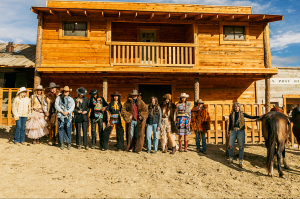
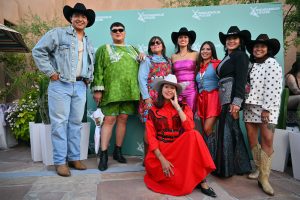
The collection, recently shown at Ghost Ranch in Abiquiu, New Mexico, began during a two-week Estudio Corazón artist residency on those same grounds. For Mountainflower, Ghost Ranch is not simply a storied landscape made famous by Georgia O’Keeffe. It is, first and foremost, a territory with deep Tewa roots, the site of Tsi Ping (Flaking Stone Village), an ancestral pueblo of the Eight Northern Pueblos, and adjacent to Tsee Pin (Flint Mountain) and Echo Canyon. Indigo Threads is her act of reclamation: taking that land’s cultural authority off museum walls and placing it on the body.
“Our heritage is not a whisper in the dust,” she says. “It is a bold statement, rising in style.”
Denim, the armor of the ranch hand, the uniform of the laborer, became Mountainflower’s canvas for a new kind of Southwestern luxury. She sourced upcycled pairs from family, friends, and her own hunts for denim that had “lived a life,” pieces still carrying the fading and wear of decades of work. Once deconstructed, each garment required meticulous pattern mapping around existing seams and scars, an act she describes as part puzzle, part quilting, entirely meditative.

The silhouettes that emerged speak directly to the land. The Chimney Rock Bubble Dress mirrors the stratified mesa formations in its voluminous tiered layers. The Kiva Step Pleated Dress, the collection’s centerpiece, features an off-the-shoulder bodice with hand-pressed pleating that echoes both the geological erosion of high-desert tuff and the architectural motif of the kiva step, which in Tewa culture represents clouds and mountains. A gradient of indigo shades across the skirt mimics the New Mexico sky just before rain breaks. Every fold, Mountainflower notes, required hours of precision work that no machine can replicate.
“Slow fashion means I spend hours on details,” she explains. “It requires time, precision, and a deep respect for the material’s history. This practice is an act of environmental sovereignty.”

That philosophy predates any contemporary sustainability movement. In Mountainflower’s studio in Ohkay Owingeh, the Tewa principle of resourcefulness and care for materials is not a trend; it is a continuation of a worldview she was raised within. Her current palette draws almost entirely from deadstock material and fabrics given at giveaways and ceremonies, an extension of Indigenous gift culture translated into design practice.

The timing of the Ghost Ranch presentation carries additional resonance. Mountainflower’s residency overlapped with the development of Tewa Nangeh, an exhibition at the Georgia O’Keeffe Museum in Santa Fe, in which Tewa artists mapped the landscape through Indigenous names and stories, centering cultural authority over a geography long framed through a modernist, colonial lens. Indigo Threads extends that mapping into wearable form, a living archive stitched from repurposed cloth and ancestral knowledge.

Looking ahead, Mountainflower plans to introduce beadwork into the collection: intentional pops of color she likens to the bright flash of a mountain flower against a monochromatic desert shadow. The deep indigo foundation will remain, but the beads will represent what she calls “blooming life,” a celebration of growth through detail. Her ambition is nothing less than a global standard for what Indigenous couture can be: deeply rooted, unapologetically sovereign, and built to last as long as the mesas themselves.