





There is a version of beadwork appreciation that stays on the surface: the colors, the symmetry, the way light catches a finished piece. And then there is the version that Stevens & Snyder want you to sit with: the hours, the cost, the ache in your hands, and the understanding that what you’re making may outlive you.
Adrian Stevens (Northern Ute, Shoshone Bannock, San Carlos Apache) and Sean Snyder (Navajo, Southern Ute) have been creating beadwork for most of their adult lives. For Snyder, the practice traces back to his grandmother, to his aunts, to watching the women in his family work.
“Beadwork for me really means family. It means tradition,” Snyder said. “Beadwork was a practice passed down from my grandma to my aunts, and that’s where I learned how to bead. I learned to bead when I was about 14 or 15 years old. All of my first projects were just for my family, just making stuff to give away, making my sisters look good for their best moments.”

For Stevens, the act of beadwork carries a different kind of permanence.
“Outside of aesthetics, I think it makes it generational,” he said. “A lot of the pieces that are artifacts here at the museum have been passed down from family members and become a part of collections. To see ourselves in that same space and creating at that same level is timeless. It’s going to be here long after I’m gone.”

That sense of legacy is what drives the pair to treat every piece as a serious object. But they are also clear-eyed about what the practice costs; in time, in physical energy, and increasingly, in dollars.
“I think people misunderstand the time it takes to create and the investment that we make as artists to pour into our artwork,” Snyder said. “It can be mentally taxing, physically taxing. Beadwork as a practice takes a lot of effort, and I think that’s something we want people to understand about all of our beadwork practices: the time it takes. That’s why we value ourselves and our time so much.”
Stevens continued: “The materials are expensive, to have an array of colors and to buy a hank of a color. You can’t just make beadwork with one color. You have to have all of the colors under the rainbow, so just to have the amount of supplies, needles, thread, not only is it taxing on your hands and your body, but people don’t often understand what it takes to have the supplies to create beadwork in general, from the canvas to the threads, needles, beads. It’s a lot.”
The economics of craft have not gotten easier. “It really speaks to our current economic situation; post-COVID, acquiring beads has gotten more expensive with taxes, tariffs on everything, supplies in general,” Snyder noted.
Understanding that context reframes the price points that sometimes give people pause. The Beaded Birkin 25, their award-winning centerpiece that caught the attention of Vogue, sold in the range of $25,000 to $30,000. That number is not arbitrary. It reflects materials, time, and a deliberate choice to position their work alongside the luxury goods that inspired it.
“I want these pieces, their value to just go up and appreciate and sell,” Stevens said. “I want our collectors to be able to resell them at a higher price.”
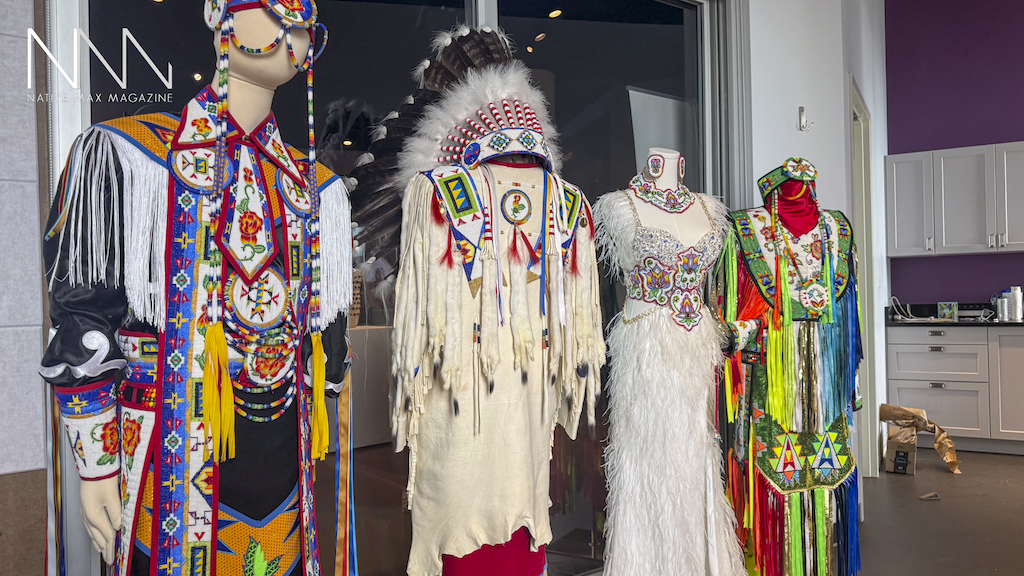
The Plume Woman Debut Dress will be apart of the the DAM installation along with the Ruby Moccasins. Photo: Kelly Holmes.
The pieces created inside the Denver Art Museum’s studio during the residency will join those ranks. Selected works are now part of the museum’s permanent collection. Others are heading to events throughout the summer season. The beads being placed today are the museum artifacts of tomorrow.
“That practice slowly developed me as a beadwork artist,” Snyder said. “To continue to bead for my family, even my puppy here, who’s in beadwork, it means tradition, and it really means love for me.”
There is no shortcut in a beaded piece by Stevens & Snyder. Every project starts with intention and ends with something built to last. If you are lucky enough to own one, you are holding hours, and a practice that stretches back generations. Their work is available at stevensandsnyder.com, and their studio pieces from the DAM residency will be on view beginning August 1.